


The Five Elements in Chinese Metaphysics: Understanding How Energy Moves, Changes, and Creates Balance


By Melanie Norman, Master Practitioner of Classical Feng Shui, Bazi, TCM , Date Selection
Chinese Medicine, Feng Shui, and BaZi may appear to be different systems, but they share one essential language: the Five Elements.
Wood, Fire, Earth, Metal, and Water are not simply physical substances. In Chinese Metaphysics, they describe five distinct ways energy moves, develops, transforms, and responds to change.
Understanding these patterns helps us see why certain times support growth, why others call for restraint, why some environments feel nourishing, and why our personal energy is never completely static.
The Five Elements give us a framework for understanding the movement of Qi through nature, the seasons, our homes, our health, and our personal BaZi charts.

Why Five Elements?
Western and Greek traditions commonly speak of four classical elements:
Earth • Air • Fire • Water
Chinese Metaphysics uses a different model:
Wood • Fire • Earth • Metal • Water
The Chinese system is known as Wu Xing 五行.
Although it is often translated as the “Five Elements,” a more accurate interpretation is the Five Phases or Five Movements.
This distinction is important.

Wu Xing is not describing five fixed objects. It describes five stages of movement and transformation. Each phase shows us a different way Qi behaves as it moves through time.
That is why the Five Elements are so important in Feng Shui, BaZi, Classical Chinese Medicine, seasonal living, and Chinese astrology.
They allow us to recognize patterns.

WOOD 木
Growth • Vision • Expansion
Wood represents beginnings.
Think of a plant emerging from the earth in spring. Its natural movement is upward and outward. It wants to grow, explore, expand, and move toward the light.
Wood energy is connected with:
Growth • Vision • Initiative • Planning • Direction
Wood encourages us to begin something new, establish a direction, and take purposeful action.
Its season is Spring, when nature awakens and begins another cycle of growth.
When Wood energy is functioning well, there can be a strong sense of direction, creativity, flexibility, and forward movement.
Wood asks:
Where am I going next?

FIRE 火
Warmth • Visibility • Connection
If Wood represents growth and possibility, Fire represents expression.
Fire radiates outward.
It brings warmth, movement, enthusiasm, visibility, communication, and human connection. It is the energy that takes an idea and allows it to be seen.
Fire is connected with:
Expression • Joy • Visibility • Connection • Action
Its season is Summer, when Yang energy reaches its fullest expression.
Fire can bring people together, increase recognition, stimulate communication, and transform potential into action.
This is why Fire also has such an important relationship with visibility, reputation, and recognition in Chinese Metaphysics.
Fire asks:
What am I ready to express and bring into the light?
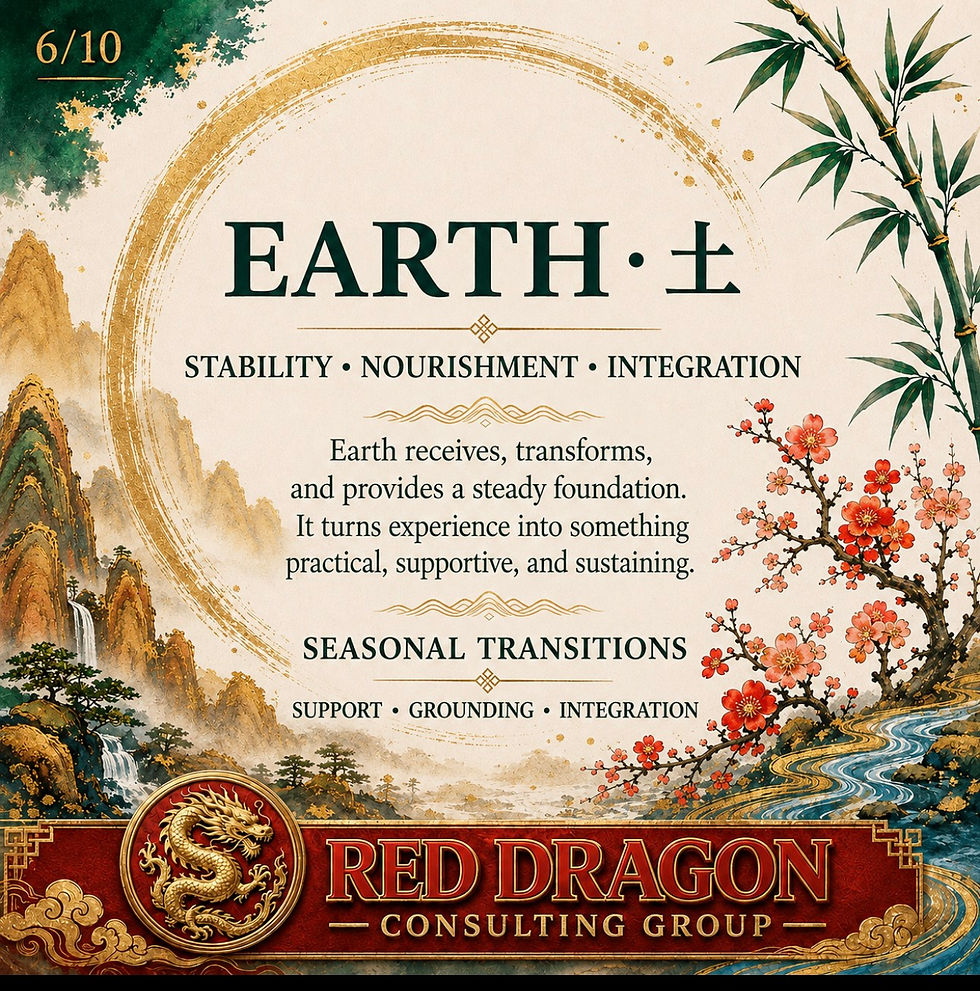
EARTH 土
Stability • Nourishment • Integration
Earth receives.
It gathers, supports, stabilizes, and transforms experience into something useful and sustainable.
Earth represents the foundation beneath us.
Its qualities include:
Support • Grounding • Nourishment • Stability • Integration
Unlike the other elements, Earth is strongly associated with the transitions between seasons. It helps us pause, digest what has happened, and prepare for the next phase.
Earth reminds us that growth cannot continue endlessly without integration.
There must also be time to absorb, nourish, organize, and create stability.
Earth asks:
What needs to be strengthened, supported, or brought back into balance?

METAL 金
Structure • Refinement • Boundaries
Metal is the energy of discernment.
As nature moves into autumn, the expansive energy of spring and summer begins to contract. What is no longer needed begins to fall away.
Metal helps us identify what is essential—and release what is not.
Metal represents: Clarity • Structure • Precision • Refinement • Boundaries • Discernment
Its season is Autumn.
Healthy Metal energy helps us organize, simplify, establish standards, make clear decisions, and create appropriate boundaries.
It can also help us recognize when something has completed its purpose.
Metal asks:
What should remain—and what is it time to release?

WATER 水
Depth • Storage • Potential
Water is the deepest and most inward of the Five Elements.
Its energy is associated with rest, reserve, wisdom, stillness, and hidden potential.
Its season is Winter.
During winter, nature appears quiet, yet tremendous potential is being stored beneath the surface.
Water represents:
Rest • Wisdom • Depth • Adaptability • Storage • Potential
Water does not always push forward.
It waits.
It adapts.
It gathers strength.
And when the timing changes, that stored energy becomes the foundation for another cycle of growth.
Water asks:
What needs time, patience, or deeper reflection before the next movement begins?
The Five Elements Are a Cycle
The beauty of Wu Xing is that none of these energies exists alone.
One phase naturally leads into another.
Water nourishes Wood.
Wood feeds Fire.
Fire creates Earth.
Earth produces Metal.
Metal supports Water.
This is commonly called the Productive or Generating cycle.

Nature continuously moves through these phases.
Growth leads to expression.
Expression eventually requires grounding.
Grounding creates structure.
Structure eventually gives way to rest and renewal.
Then the cycle begins again.
There is also a regulating relationship between the elements that helps prevent any one energy from becoming excessive.

The Controlling Cycle
The Controlling Cycle keeps the system from becoming excessive:
Wood controls Earth.
Earth contains Water.
Water controls Fire.
Fire melts Metal.
Metal cuts Wood.
This does not mean one element is “bad” for another. Healthy control provides direction, structure, and balance.
Both cycles are necessary.
Growth without regulation can lead to excess. Control without nourishment can lead to depletion. For example, Wood needs Water to grow, but it also needs Metal to keep its growth from becoming uncontrolled.

When the Elements Lose Balance
An element can become excessive, depleted, blocked, or unsupported.
Too much Fire may show up as urgency, overstimulation, or constant visibility without enough rest.
Too little Water may mean reserves are being drained faster than they can be replenished.
The important point is that no element is inherently good or bad. Its meaning depends on the entire energetic pattern.
This is especially important in BaZi. You are not simply “a Wood person” or “a Fire person.” Your chart contains all five elemental relationships, and their usefulness changes according to your overall chart, your luck cycles, the year, the month, and your environment.
This is why balance in Chinese Metaphysics does not mean having equal amounts of all five elements.
Balance is more dynamic than that.

Balance Is Always Changing
We are each born with a particular elemental pattern.
But that pattern does not exist in isolation.
The seasons change.
Years change.
Monthly energies change.
Our homes change.
Our careers change.
Our relationships change.
Our health changes.
Our environment changes.
Each of these introduces new influences into the energetic system.
This is one reason BaZi and Feng Shui are so valuable: they allow us to study not only the energy we were born with, but also the energy arriving now.
True balance does not mean trying to accumulate equal amounts of Wood, Fire, Earth, Metal, and Water.
It means understanding what the system requires at a particular moment.
Sometimes we need more Wood—the courage to begin.
Sometimes Fire—the confidence to be visible.
Sometimes Earth—the stability to slow down.
Sometimes Metal—the clarity to simplify and establish boundaries.
Sometimes Water—the wisdom to wait.
The Question Is Not “Which Element Am I?”
A more meaningful question is:

What does my energy need now?
That is where Chinese Metaphysics becomes practical.
The Five Elements provide a language for understanding timing, health, relationships, environment, decision-making, and personal development.
Once you begin to recognize these movements, you start to see them everywhere—in the seasons, in your surroundings, in your BaZi chart, and in the changing chapters of your life.
The Five Elements are not static.
They are a living cycle of transformation.
And when we understand how that cycle is moving, we can make better-informed decisions about when to grow, act, stabilize, refine, release, or rest.
About Melanie Norman
Melanie Norman is a professional classical Chinese Metaphysics consultant, educator, and the founder of Red Dragon Consulting Group. Specializing in BaZi (Chinese Astrology), Classical Feng Shui, and Traditional Chinese Medicine (TCM) principles.
Melanie empowers individuals and business owners to align their lives, spaces, and strategies with natural energetic cycles. Through her consultations, masterclasses, and digital resources, she translates ancient wisdom into practical, modern-day roadmaps for wealth, health, and personal growth.
Connect with Melanie and book a Bazi Chinese Astrology reading with her https://www.reddragonconsultinggroup.com/book-online
ALIGN • ACT • ACHIEVE
Red Dragon Consulting Group


Comments